
A Sub-Second Autonomous Inbound & Outbound Voice Core
Engagement Blueprint · Voice AI Operations (Powered by Neno Voice)
The Operational Problem
Traditional IVR systems and human call centers are structurally fragile and expensive. Customers endure 15-minute hold queues navigating rigid press-1 menus, only to be transferred between multiple human agents who ask for the same verification details repeatedly. Human operator burnout drives 40%+ annual turnover, leading to inconsistent customer support quality, compliance violations, and unsustainable per-minute staffing costs.
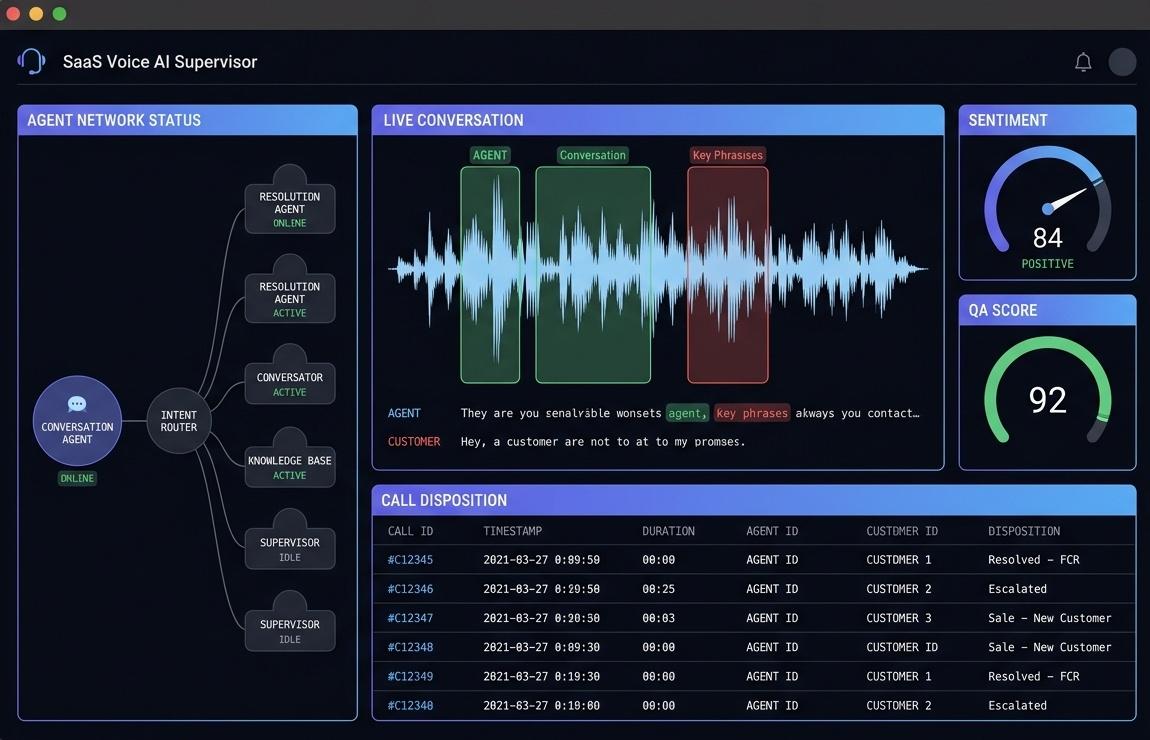
Agent Mesh Topology
Coordinated autonomous sub-agents executing specialized domain tasks under a deterministic supervisor state machine.
| Agent Node | Core Engineering Responsibility |
|---|---|
Conversation & Streaming Agent | Manages bidirectional audio buffers, voice activity detection (VAD), and natural interruption handling over edge WebRTC connections. |
Intent Classifier & Router Agent | Decodes caller utterances into domain intents, sentiment scores, and urgency tiers within 30 milliseconds. |
Transactional Resolution Agent | Executes authorized database read/writes (refunds, order updates, booking changes) with transactional rollback safety. |
Regulatory Compliance & QA Agent | Monitors live call audio for compliance checklists (GDPR, PCI-DSS disclosure, disclaimer consent) in real-time. |
Human Escalation Agent | Bridges the call to a human supervisor with zero audio drop, passing a real-time transcript and sentiment timeline. |
Orchestration Pattern
Pipeline-Parallel Streaming Orchestrator. Speech-to-Text (STT), LLM inference, and Text-to-Speech (TTS) run concurrently over streaming WebSockets. While the customer speaks, interim tokens are evaluated by early-exit intent classifiers, allowing the TTS engine to begin synthesizing response phonemes before the caller even finishes pausing.
End-to-End Execution Flow
Step-by-step event loop from inbound trigger to verified transactional completion.
SIP Ingestion & Edge Audio Streaming
The caller connects via carrier SIP trunking into low-latency edge WebSockets running Deepgram Nova-2 speech recognition.
Zero-Latency Voice Activity & Interruption
Custom VAD models detect pauses down to 180ms while gracefully stopping AI speech playback the instant the user speaks.
Intent Extraction & Context Retrieval
Parallel RAG vector search pulls customer CRM records, purchase history, and verified policy constraints in milliseconds.
Deterministic Action Execution
The agent calls secure internal microservice APIs to cancel subscriptions, reschedule deliveries, or collect secure payments.
Real-Time QA & Disposition Logging
Once the call concludes, full structured call analytics, sentiment tags, and recording summaries are pushed directly to Neno CRM.
Full Stack Architecture
Production stack components configured for horizontal scalability, sub-second latency, and data isolation.
What We Deliver
Carrier-grade telephony integration running on dedicated cloud instances or on-premises SIP gateways. Complete audio streaming server code, custom voice cloning profiles, latency-optimized turn-taking logic, API connectors for billing/ticketing systems, and full supervisor monitoring suites.
Target Outcome Model
Designed for high-volume enterprise contact centers requiring sub-second human-like responsiveness with strict compliance guarantees.
Natural interruption (barge-in) and network jitter. In real phone calls, callers mumble 'uh-huh', cough, or interrupt mid-sentence. If the agent stops talking on every cough, the experience is broken; if it speaks over the caller, it feels robotic. We deploy fine-tuned acoustic classification at the edge to distinguish active user interruptions from passive acknowledgment murmurs, cutting accidental speech aborts to near zero.
Ready to deploy this capability into production?
Work directly with Neno Technology's forward-deployed engineering squads to scope, build, and deploy this blueprint inside your cloud environment.
Talk to the engineering team