

01Optimizing Agent Decision-Making with Gemini Decisions API
Current agent systems use general-purpose large language models (LLMs) as decision engines. A common pattern routes user queries to specific tools or classifies content against policies. This involves sending a prompt, receiving text output, and parsing that output for the required decision. This method has limitations.
Processing multimodal inputs, like a support ticket with text and a product image, requires the LLM to interpret all modalities, generate a textual decision, and then undergo parsing. This sequential process increases latency, especially when the LLM must consider multiple factors or answer distinct questions. Latency and costs rise with large multimodal datasets and complex parsing.
General-purpose LLMs are not optimized for calibrated, probabilistic outputs; they produce text. Extracting a definitive binary outcome or specific choice from this text often requires custom heuristics or confidence thresholds. This adds engineering complexity and potential failure points; minor text generation deviations can cause parsing logic misinterpretations.
02Gemini Decisions API for Structured Decision Outputs
Google's Gemini Decisions API, using the gemini-decision-1 model, addresses these issues. This API is engineered for rapid, closed-set decision-making across various input modalities, not text generation.
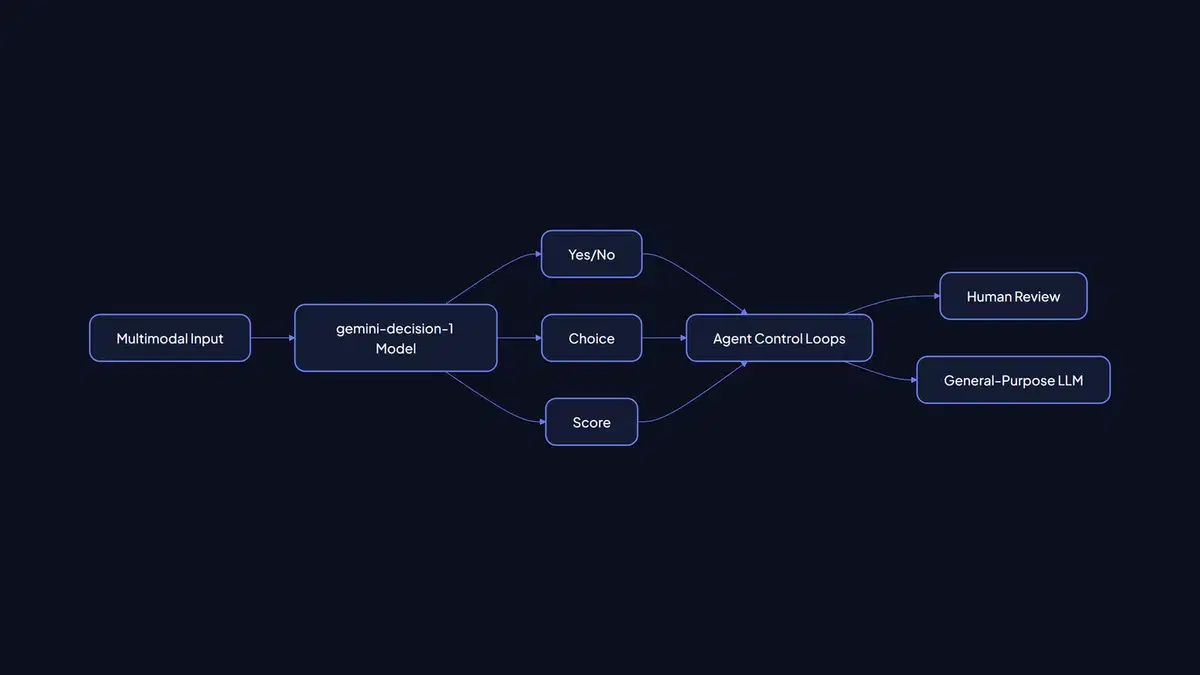
Users submit a single multimodal input—text, images, audio, video, or PDFs—with up to 1,000 questions. The API evaluates these questions in a single forward pass, returning probabilistic outputs and confidence scores. This differs from traditional token-by-token generation.
- Google reports end-to-end latency of 150-250 ms. A key economic advantage is its pricing: zero output token costs. Google states this makes it approximately 5x more cost-effective than using Gemini 3.5 Flash-Lite with their Interactions API for comparable decision tasks. The pricing of $0.10 per 1 million input tokens, with no output token charges, is advantageous for high-volume routing or classification.
The API supports three question types:
- Yes/No: For binary decisions, returning the probability a condition is true.
- Choice: For selecting from 2 to 255 predefined options, returning the most probable choice and normalized probabilities for all candidates.
- Score: For evaluating against an ordered rubric, returning a weighted score and per-level probabilities.
- Each response includes a confidence score from 0 to 1. These structured, probabilistic outputs are directly consumable by agent control loops, eliminating text parsing.
03Re-architecting Agent Control Loops
Adopting the Gemini Decisions API necessitates recalibrating agent control logic design. Existing systems, based on textual outputs, require modifications.
Transitioning from Text Parsing to Probabilistic Evaluation
The primary change involves shifting from string manipulation and regular expressions to handling numerical probabilities. Previously, an LLM might answer "Should this query be routed to customer support or sales?" with "The best department is sales." This would be parsed. With the Decisions API, a 'choice' type question yields a probability distribution for 'customer support' and 'sales'. The control loop then evaluates these probabilities against thresholds to make a decision.
- For example, re-engineering a RAG pipeline's initial query classification eliminated a dedicated LLM call for determining if a query pertained to billing or technical support. The Decisions API handles this classification in one pass, outputting category probabilities. The agent code executes a simple check, such as
if response.choices[0].probability > 0.8:. This reduced latency by approximately 500 ms and lowered costs for that function by over 60%.
Incorporating Confidence Scores for System Resilience
Confidence scores are critical for fault-tolerant systems. Low confidence scores or highly overlapping probabilities for multiple choices can trigger fallback mechanisms. These include escalating to a human agent, rerouting to a general-purpose LLM for secondary evaluation, or prompting the user for clarification.
- Consider content moderation where the API scores content against 'hate speech', 'spam', and 'appropriate' criteria. If the confidence score for the highest-ranked category is below 0.7, or if probabilities for 'hate speech' and 'appropriate' are within 0.1 of each other, the system flags content for human review instead of automatic action.
Native Multimodal Processing
Native multimodal evaluation offers a significant architectural advantage. Instead of preprocessing images or audio separately and feeding textual descriptions to an LLM, these modalities are submitted together. The API can process a scanned PDF claim form alongside photographs of damaged property to evaluate questions like "Is the damage consistent with the description?" (Yes/No) or "Rate the severity of damage on a scale of 1-5" (Score). This streamlines pipeline architecture.
04Application Scope for Gemini Decisions API
The Gemini Decisions API is optimized for specific task categories:
- Tool Selection: Determining the appropriate function or API call for an agent.
- Content Grading/Moderation: Evaluating content against predefined criteria.
- Policy Compliance: Verifying adherence to defined rules.
- Classification/Routing: Directing inputs to the correct handler.
This API is not suited for generative tasks like creative text production, summarization, or open-ended conversational agents. Its strengths lie in speed and accuracy for bounded decision problems.
Output calibration requires careful attention. While Google reports strong calibration, validating confidence scores within the specific application context is prudent. The definition of a 'high' confidence score can vary. Initial threshold settings often require adjustment based on observed performance data. For example, in one project classifying product reviews, the 'choice' type initially assigned high probabilities to multiple incorrect categories before prompt adjustments and threshold fine-tuning.
05Sources
- [Gemini Decisions API](https: //blog.google/innovation-and-ai/technology/developers-tools/gemini-decisions-api/) (blog.google)
- [Discussion: Gemini Decisions API](https://news.ycombinator.com/item?id=50456791) (Hacker News)