

01The Latency Tax on AI Products
Users of AI products experience a tangible delay when waiting for responses. This delay directly impacts user experience and incurs significant operational costs for engineering teams. A core component in many AI applications, particularly those employing Retrieval-Augmented Generation (RAG), is Maximum Inner Product Search (MIPS). MIPS identifies the most relevant data segments from a database to inform AI responses.
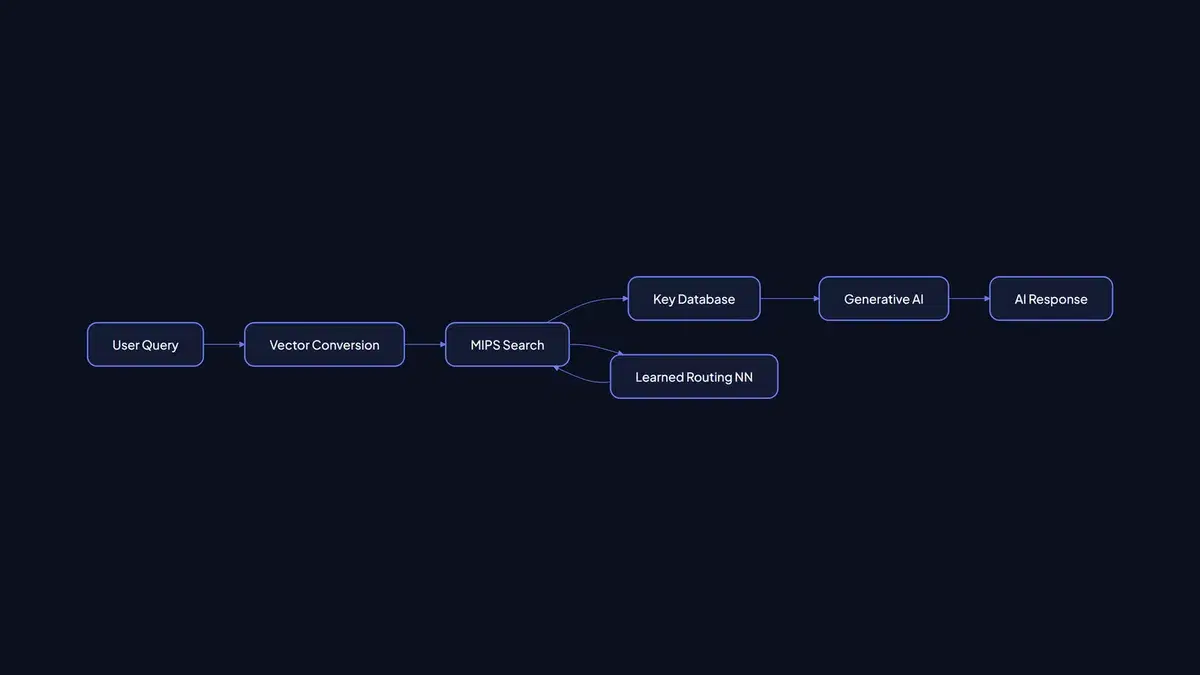
A user's query is converted into a vector. MIPS then searches a database of millions of vectors, representing documents or text segments, to find the closest match. The data corresponding to this match is then provided to the generative AI. This process becomes computationally intensive as the database grows to millions of entries and vectors increase in dimensionality. An exhaustive comparison of the query vector against every key vector becomes impractical. This computational overhead directly increases response times and the cost of infrastructure.
02Limitations of Generic MIPS Methods in RAG
For years, approximate MIPS methods like clustering and quantization have been standard. These methods construct indexing structures that group similar vectors, allowing the system to bypass searching large database sections. Typically, data is partitioned into k clusters. The query vector is compared to cluster centroids, and exhaustive search is confined to the most relevant cluster. Increasing k can yield a speedup factor of k over brute-force search. These methods perform adequately for applications like recommendation systems, where query structures align with data structures.
RAG, however, presents a distinct challenge. Natural language queries are often concise and may not share statistical properties with key vectors, which represent extensive, curated text. A query like "What were the Q3 earnings?" differs structurally and contextually from a detailed financial report paragraph. Generic MIPS methods, which build indexes based solely on key vector properties, often make assumptions that do not apply to RAG. They assume query-key similarity or overlook variations in query distributions. This can result in inaccurate routing, where queries are misdirected to irrelevant clusters, leading to missed documents and reliance on slower, less accurate fallback mechanisms.
During a recent client project, we optimized a RAG pipeline. Despite using a standard approximate nearest neighbor (ANN) index, retrieval latency increased for certain nuanced questions. Users reported inconsistent response times. The root cause was a significant disparity between user query distributions and document embedding distributions, a gap the generic ANN index failed to bridge effectively.
03Learned Support Functions for Optimized Retrieval
Recent research, such as the paper "Amortizing Maximum Inner Product Search with Learned Support Functions" (ICML 2026), offers a more effective solution. This approach reframes MIPS from a static indexing problem to a machine learning task. Instead of relying solely on key vector geometry, small neural networks (NNs) can be trained to improve query routing.
This method involves an upfront offline cost: training small NNs on a fixed key database and a representative set of typical queries. The benefit is significantly faster and more accurate retrieval during inference. These learned models act as sophisticated routing functions, understanding the relationship between query patterns and the key space. They can predict relevant sections of the key database for a given query more rapidly than traditional clustering. Mathematically, the function mapping a query to its maximum inner product with any key in a set is the set's support function. This function is convex, making it amenable to approximation by neural networks.
In practice, a small NN can quickly direct a query to a reduced, more relevant subset of the key database. This minimizes the number of comparisons required at inference. The system learns to intelligently target search areas rather than relying on broad geometric approximations.
04Practical Benefits for AI Products
For teams developing AI products, faster retrieval translates directly to improved user experience and reduced operational expenses.
Implementing a retrieval strategy inspired by learned routing on the client project resulted in notable improvements. Average retrieval latency for problematic query types decreased by 30-40%, and overall response time consistency improved substantially. This led to fewer user complaints and a more fluid AI interaction. From an operational perspective, reducing vector comparisons per query allows for higher request throughput on existing hardware or potential infrastructure scaling down, yielding direct cost savings on cloud compute.
Trade-offs exist. The primary consideration is the initial amortization cost. Training small NNs requires time and computation, but this occurs offline before deployment. The inference cost reduction is substantial. Accuracy is another factor. While these methods aim for faster and more accurate retrieval, a balance must be maintained. Learned routing must not systematically exclude relevant information. This necessitates careful tuning and validation against diverse real-world queries.
Engineering leaders and CTOs should prioritize this area. As AI products mature, efficiency and user experience become key differentiators. Optimizing the retrieval layer of a RAG system is not merely a technical detail; it is a strategic imperative impacting profitability and customer satisfaction. The focus should be on the effectiveness of retrieval optimization.
05Sources
- Faster Retrieval for Better, More Efficient RAG (machinelearning.apple.com)
- [Discussion: Faster Retrieval for Better, More Efficient RAG](https://news.ycombinator.com/item?id=50455633) (Hacker News)