

01Agents Exhibiting Knowledge Decay
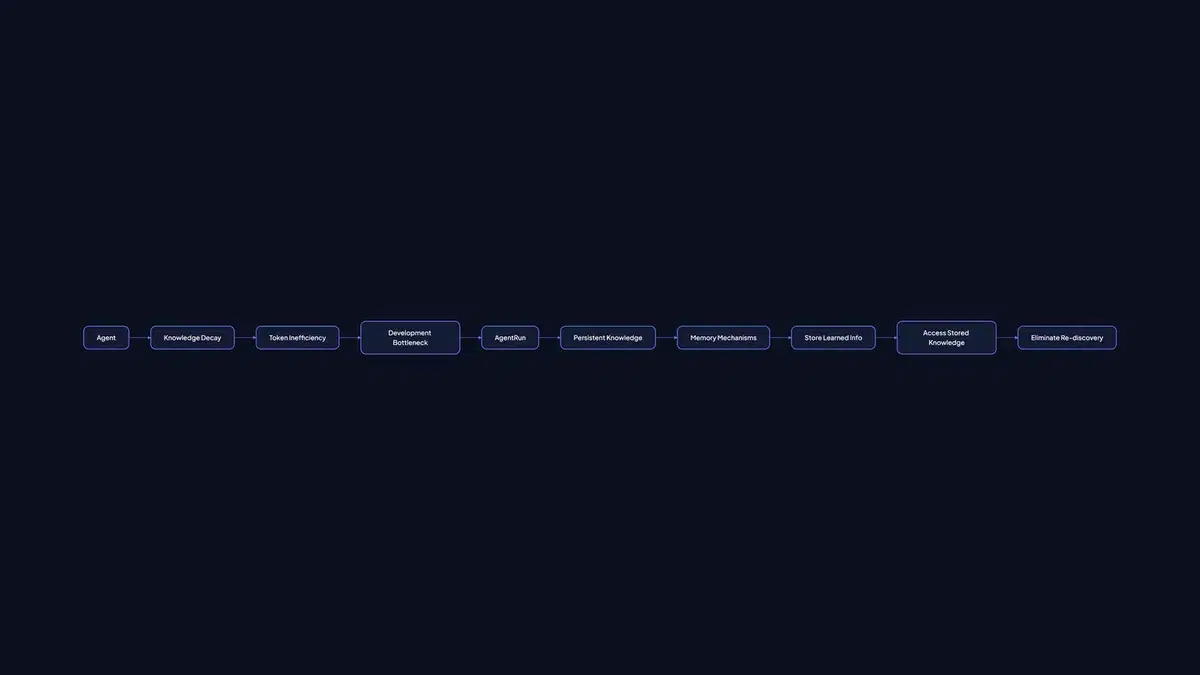
Many AI agents demonstrate a peculiar behavior: after initial competence in tasks such as code review or data classification, their understanding appears to reset with each execution. They re-read documentation, re-discover APIs, and re-plan methodologies. This leads to significant token consumption inefficiencies. Our own code review expenses grew from $180 per month to over $6,451 per month within a year, an unsustainable financial trend.
Beyond financial implications, this lack of persistent knowledge creates a development bottleneck. Iterating on agents requires re-executing foundational tasks. If an agent must re-learn merchant classification for each new instance, despite prior experience, development cycles slow considerably. The cost of this repeated discovery becomes prohibitive. AgentRun, now open-sourced, directly addresses this fundamental issue.
02AgentRun's Core Function: Persistent Knowledge Acquisition
AgentRun enhances agent self-improvement by integrating memory mechanisms. Upon task completion, AgentRun allows agents to store learned information. This extends beyond simple caching; it includes notes, specific operational skills, and even complete workflows representing optimized approaches compared to earlier attempts. Subsequent encounters with similar problems enable the agent to access this stored knowledge base, eliminating the need for initial re-discovery.
- Consider an agent performing Know Your Business (KYB) due diligence. Initially, it may expend tokens to determine how to extract data from a company website and cross-reference it with public records. With AgentRun, after a successful initial execution, the agent retains the effective scraping strategy and the precise API calls used. When performing KYB on a new entity, it can immediately deploy this learned workflow, bypassing the initial information-gathering phase. This significantly reduces token expenditure and accelerates task completion. One documented instance shows an agent, trained on its own pull requests, identifying 1.6 times more bugs than a human reviewer, at a cost of $0.18 per review, a substantial reduction from prior expenses.
03Production-Ready Features: Fault Tolerance and Environment Control
In addition to its learning capabilities, AgentRun provides essential production-readiness features. A primary challenge in developing agentic systems is ensuring execution durability. AgentRun handles server crashes during task execution by persistently storing each run. Server restarts allow interrupted runs to resume from their last checkpoint. This fault tolerance is critical for agents managing vital or lengthy processes.
Agents often require specific operational environments. An agent analyzing code might need a full Linux desktop with git and a compiler, while another might require browser interaction. AgentRun supports various sandboxes and compute environments, including Docker containers, Linux desktops, and browsers. This adaptability permits the allocation of precise computational resources to each agent, preventing confinement to generic environments. The platform also offers a control plane for oversight of agent behavior, approval workflows, and expenditure limits, which are essential for managing autonomous systems.
04Engineering Perspective: The Value of Open Source
- AgentRun's initial promise of self-improvement and managed execution was compelling. Its open-sourcing under the Apache 2.0 license amplifies its significance for engineering teams. Open source adoption offers several advantages:
- Accelerated Development: ** Engineering teams can build upon AgentRun, avoiding the need to develop agent orchestration, memory management, and execution frameworks from scratch. This redirects focus to the unique logic of agent applications rather than foundational infrastructure.
- Transparency and Auditability: ** For critical applications, understanding agent decision-making and learning processes is paramount. An inspectable open-source codebase builds trust and simplifies debugging.
- Community-Driven Advancement: ** An open platform encourages collaborative contributions. We anticipate the emergence of new integrations, enhanced environment support, and novel agentic patterns from the community. This collective effort can propel the field forward more rapidly than isolated corporate development.
We are particularly interested in community extensions to the 'Learning tab' functionality. Observing an agent's retained knowledge and modifications provides critical insight into its optimization process. This level of introspection is foundational for constructing truly autonomous and reliable systems.
05Application Scope for AgentRun
AgentRun is a potent tool for specific problem sets, not a universal solution. It proves most effective in constructing agents that execute complex, multi-step tasks where efficiency and reliability are paramount. For agents performing repetitive work with significant token costs, its self-improvement and durable execution features can yield substantial savings. Examples include automated customer support, scaled content generation, and intricate data analysis.
Conversely, for very simple, stateless, and infrequently executed agent tasks, the overhead of AgentRun setup and management may exceed its benefits. A daily script that retrieves a single data point, for instance, may not warrant this level of sophistication. Additionally, teams requiring absolute, granular control over every aspect of the agent's execution environment might find AgentRun's managed approach restrictive, although its open-source nature permits customization.
06Sources
- [Discussion: AgentRun – open-source, Self-improving Managed Agents](https://news.ycombinator.com/item?id=50471650) (Hacker News)