

01Fragmentation in Developer Tooling
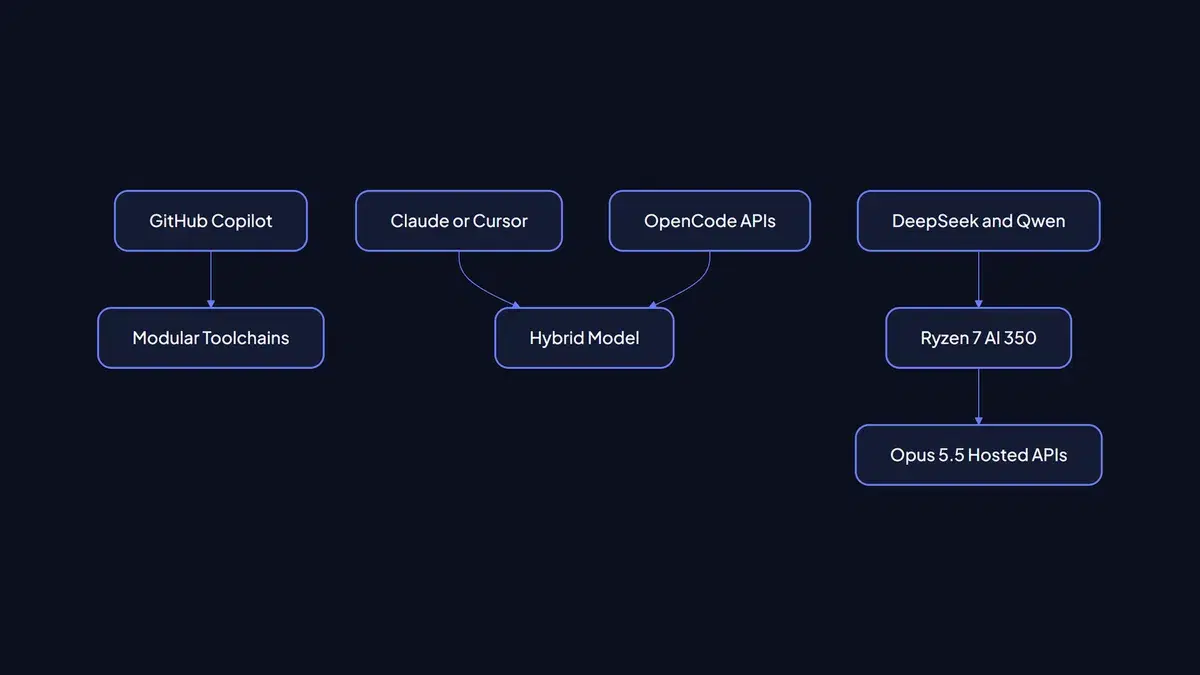
Developer workflows are shifting away from monolithic IDE integrations like GitHub Copilot toward modular, custom toolchains. Engineers now prioritize the ability to swap models with the same frequency as switching git branches.
Teams currently follow two distinct strategies: subscription-based access to platforms like Claude or Cursor, or pay-as-you-go architectures using APIs from providers like OpenCode. This modularity is a technical necessity because no single model performs optimally across every task type.
02Failure Modes in Architectural Reasoning
High benchmark scores do not correlate with an understanding of system architecture. In a recent production performance audit, we tasked a state-of-the-art model with optimizing a SQL query executing thousands of times per minute. The model generated complex execution plan overrides. While syntactically valid, the suggestion ignored the underlying architectural flaw. Caching the query result for 60 seconds provided a 1000x performance increase—a solution requiring three lines of code that the model failed to identify. Treat current AI agents as junior developers: they execute specific tasks rapidly but lack the domain intuition required for architectural oversight.
03Local Hardware Constraints and Privacy
- Data privacy and cost control drive the interest in running models locally. However, hardware limitations remain a bottleneck. While models like DeepSeek and Qwen offer high performance, running them on consumer-grade hardware—such as a Ryzen 7 AI 350 with 32GB of RAM—fails to match the latency and accuracy of hosted APIs like Opus 5.5.
Current engineering standards rely on a hybrid model: hosted APIs perform the heavy computational tasks, while local tools handle sensitive or scoped operations. This separation maintains velocity while protecting proprietary data.
04Designing for Portability
When constructing agentic workflows, prioritize portability over tool-specific features. Use editors that support provider swapping and constrain prompts to narrow, verifiable tasks rather than open-ended system design. If an agent proposes a complex refactor, verify whether a simpler, non-AI solution exists first. These tools augment specific workflows but cannot replace architectural judgment.
05Sources
- What's your current AI agentic setup? (news.ycombinator.com)