

01Stateful Orchestration vs. Chained Prompts for LLM Agents
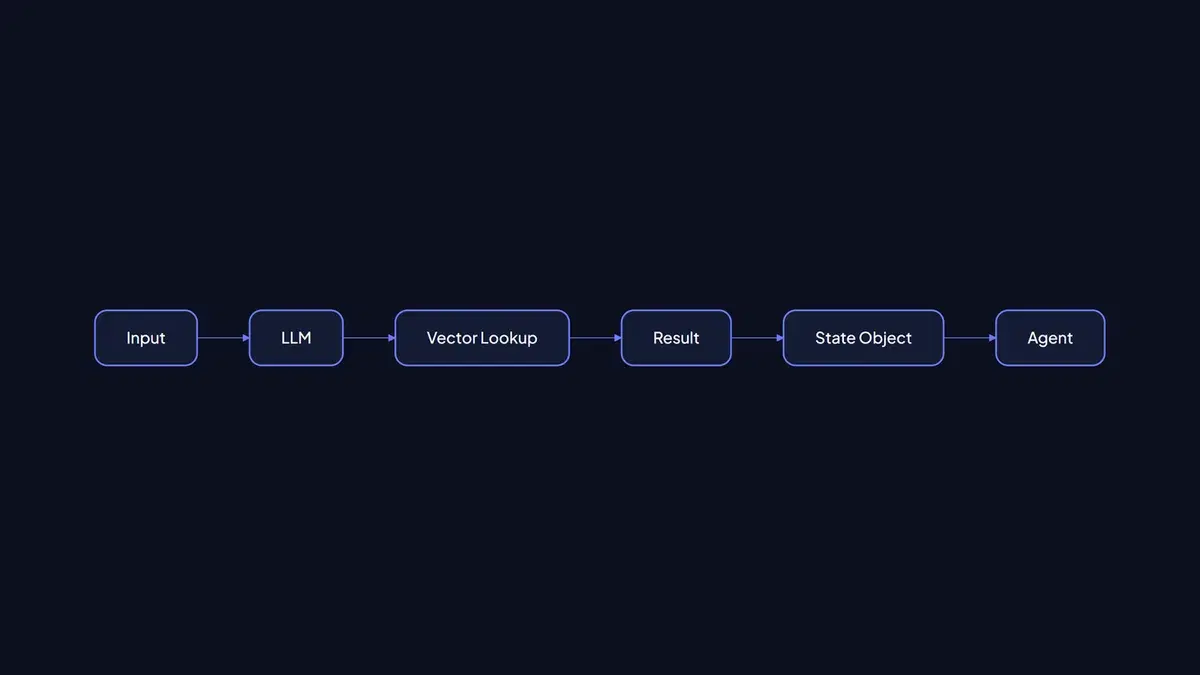
Initial LLM implementations often rely on simple sequential prompt chains. An input is processed by an LLM, potentially augmented with a vector lookup, and a result is returned. This approach falters when tasks exceed two steps. Automating a recent client's document reconciliation process revealed linear chains' insufficient context retention for handling discrepancies. A minor extraction error in step two of a linear chain would render subsequent steps invalid by step four.
We transitioned to a state-machine architecture. Here, the agent functions as an autonomous processor operating on a persisted state object, deviating from a linear flow. This design permits pausing, inspection, and resumption of execution. If an agent encounters an impasse, it can revert to a previously validated state instead of terminating. We employ Redis for state persistence, ensuring the fault tolerance required for production environments.
02Autonomy's Resource Implications
Agent autonomy introduces significant resource consumption, particularly token usage. One project involved a recursive agent that entered an infinite loop attempting to resolve an ambiguous schema definition. This agent consumed 14 million tokens in under four minutes before circuit breakers intervened.
We enforce three strict constraints on all agents:
- Max-step Limits: Each agent is configured with a hard limit on the number of reasoning steps.
- Tool-Call Cost Validation: Prior to tool execution, the orchestrator verifies that the cost of the tool call is commensurate with the task's priority.
- Human-in-the-Loop Checkpoints: For any operation modifying a production database, the state machine mandates a wait state until an authorized token is provided.
03Managing Tool Failures
Agent efficacy is directly tied to its tools. For agents querying SQL databases, the LLM's schema definition is paramount. We discontinued passing full schema dumps. Instead, we generate a condensed JSON schema containing only tables and columns relevant to the specific task. This reduces noise and significantly decreases hallucinations during SQL generation.
When a tool fails, such as an internal API returning a 503 error, the agent must handle the exception. Many framework-provided agents simply crash. We implement a retry decorator with exponential backoff around our tool execution layer. Critically, we equip agents with a 'remediation' tool. Upon a primary API call failure, the agent can elect to consult documentation or query an alternative source, avoiding outright failure.
04Practical Observability for Autonomous Agents
Tracing autonomous agents differs from microservice tracing; the agent's decision-making process must be visible. We use OpenTelemetry to track agent request lifecycles, incorporating raw prompt-response pairs as trace attributes. Without visibility into the agent's reasoning for a specific function call at 2:00 AM, effective debugging is impossible. We retain these traces for 30 days. While storage costs are substantial, this duration is essential for performing root-cause analysis on erratic agent behavior.